
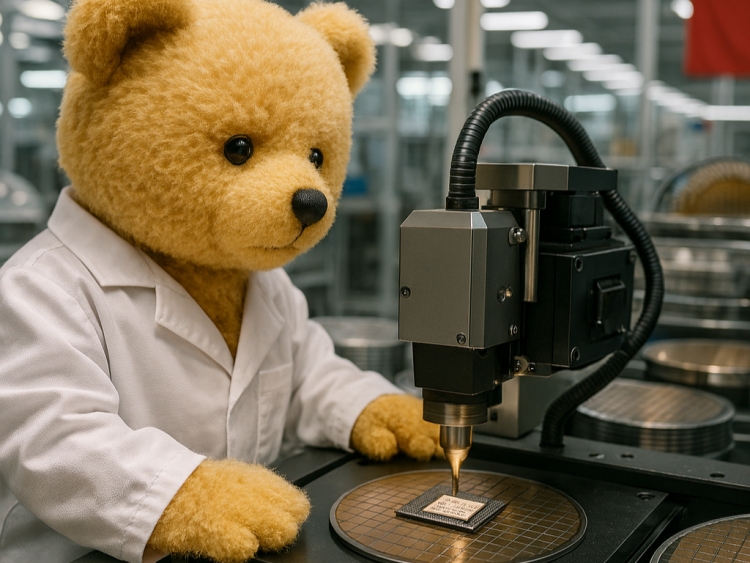
According to people familiar with the matter, Chinese fabs producing advanced smartphones and AI chips have boosted the performance of deep-ultraviolet lithography machines supplied by ASML.
US and Dutch export controls block ASML from selling its most advanced DUV systems to China, forcing fabs to rely on older tools such as the Twinscan NXT:1980i. These machines are still capable of producing seven-nanometre chips, a key threshold for modern AI development.
In chipmaking shorthand, nanometres describe generational progress rather than literal dimensions, a detail often lost in political speeches.
People familiar with the upgrades said Chinese fabs sourced components on the secondary market, including improved wafer stages, lenses and sensors that allow chip layers to be aligned with greater precision. The changes have lifted performance without requiring new machines.
These tweaks have helped raise the output of AI chips, blunting the impact of export restrictions designed to slow China’s technological rise.
Semiconductor Manufacturing International Corporation and Huawei are among the firms known to be running seven-nanometre production lines on older ASML tools. However, it remains unclear whether both secured the full set of component upgrades.
The work highlights how Chinese manufacturers are finding practical ways around a regime intended to cut them off from cutting-edge equipment.
Washington has pushed controls aimed at stopping China from accessing advanced chips, leaning on governments in the Netherlands, South Korea and Japan to tighten sales. The goal has been to choke off Chinese access across the global supply chain.
Under current rules, ASML is still allowed to provide engineering support to maintain existing machines in China. However, it is barred from improving overlay accuracy or increasing machine throughput by more than one per cent.
Multiple sources said local fabs bought components abroad and shipped them into China, with third-party engineers carrying out the upgrades on site.
ASML said it “fully complies with all applicable laws and regulations . . . The company operates strictly within these legal frameworks and does not support system upgrades that allow customers to improve performance levels beyond what is permitted by law.”
China is blocked from buying ASML’s extreme ultraviolet machines, which are essential for simpler production of leading-edge chips. That has forced fabs to rely on multi-patterning, where layers are exposed multiple times using DUV tools.
The approach raises costs, stretches machine time and lowers yield, but component upgrades have eased some of those penalties, according to people familiar with the process.
Analyst group TechInsights said this month that SMIC continues pushing multi-patterning beyond seven nanometres. It added that Huawei’s Kirin 9030 processor represents China’s most advanced manufacturing process so far.
TechInsights, chief strategy officer, Dan Kim said: “Chinese fabs have been able to achieve impressive feats without full access to the best equipment available to others like TSMC and Samsung.”
The US Bureau of Industry and Security has been examining the level of support ASML provides to Chinese customers and has been preparing tougher rules to curb even permitted servicing, according to people familiar with its thinking.
Whether those plans survive is unclear after the Trump administration signalled a truce in its trade war with Beijing.
ASML has lobbied against restrictions, arguing China is a vital market and already has what it needs for military-grade chips. Former chief executive Peter Wennink said the curbs delivered no extra security benefit for the West.
China’s newest production lines are running ASML’s newer 2050i and 2100i DUV tools, which include upgraded stage mechanisms. The Dutch government revoked export licences for both systems in September 2024, but only after many had already been shipped.
The rush paid off for ASML as its China sales hit €7.2bn in 2023, 26 per cent of total revenue, then rose to €10.2bn in 2024, 36 per cent of total sales. The company warned investors in October that China revenue would “decline significantly” next year.